

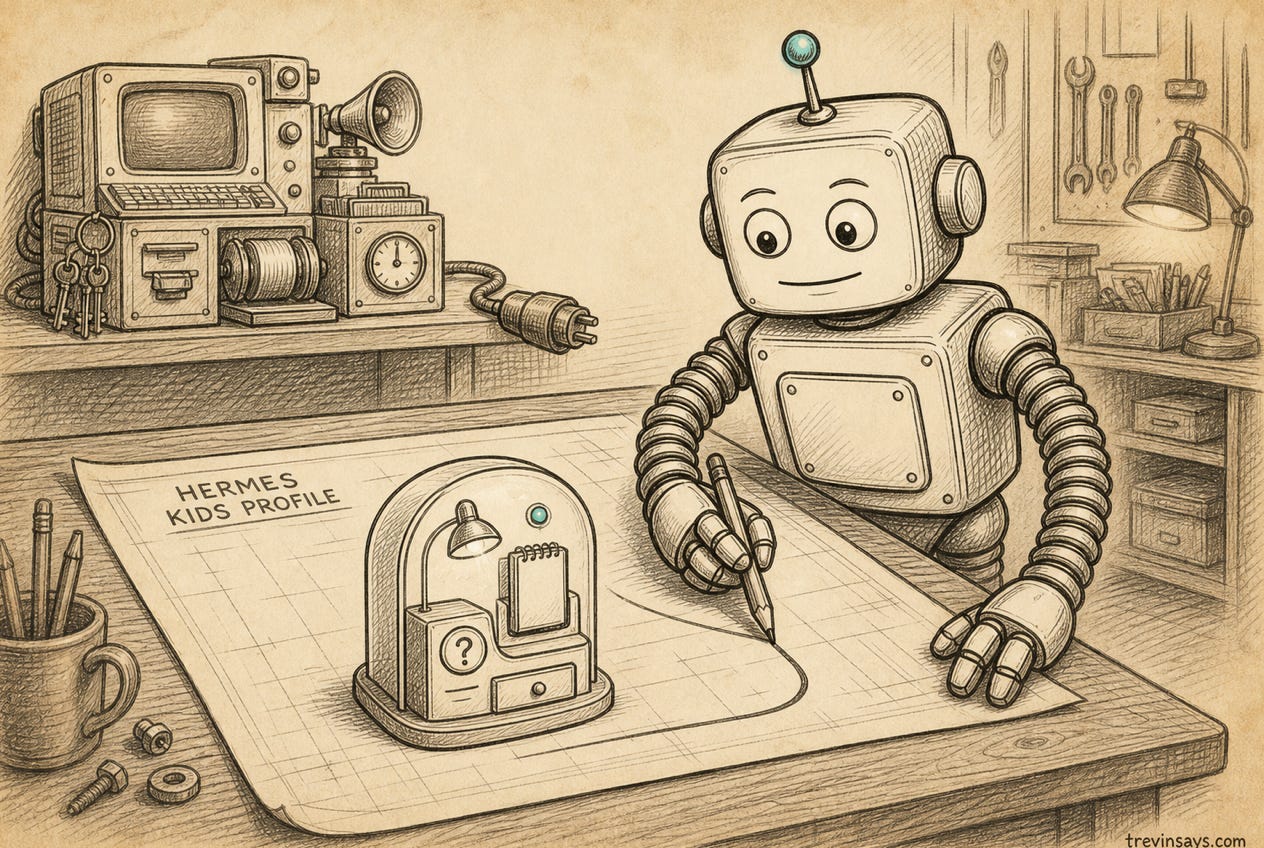
I wanted my 12-year-old daughter to use AI for learning, creative projects, and the endless questions that come with being 12. I didn’t want to hand her the same general-purpose agent I use. I also didn’t want to just hand her Claude Code and hope her vibes can stay safe.
My Hermes setup can execute files, use the terminal, send messages, schedule work, and remember a lot about me. It has my context, my credentials, and tools meant for an adult who knows what they can break. Turning off a couple of features wouldn’t make that a good starting point for a kid.
So I built her a separate Hermes profile from scratch. Then I turned the process into the open-source Hermes Kids Profile Blueprint, a parent-operated starter kit for creating a private, child-facing Hermes profile.
It isn’t a finished “kids AI” product, and it doesn’t claim to make AI safe. It gives parents who already use Hermes a concrete starting point they can inspect, change, test, and argue with.
Saying “not yet” wouldn’t solve much
The easy answer was to wait. Wait until she’s older, until the research is better, or until I’ve figured out exactly what I think about kids using AI.
She sees me use AI every day. It’s part of almost all my work and plenty of my personal life when it’s useful. Kids her age are already using it too. A 2026 JAMA Network Open study, based on device data rather than self-reporting, found generative AI use among 20.5% of kids ages 10 to 12. As you’d expect, usage rose quickly with age.
But that number says nothing about whether AI is good for kids. For me, it made waiting feel less neutral. AI use is already reaching preteens whether or not we adults have decided a set of settled rules.
The question in our house became: what would it take to say yes carefully?
A child profile is a whole system
A Hermes profile is more than a SOUL.md that gives the assistant a friendlier personality. It includes behavior rules, credentials, memory, sessions, skills, tools, background jobs, and the interfaces the person will actually use.
For a child, all of those choices matter.
Should the agent remember a passing mood? Can it search the web? What happens when voice input is enabled? Can it send a message or spend money? Does it answer homework questions directly? What family context should it know? Who can review or change the setup?
The safest useful default I could find was a fresh profile that inherits none of the adult profile’s memory or capabilities. Start with conversation. Add a small amount of parent-approved family context when it helps, and add a tool only when it serves a real purpose. Keep credentials, spending, messages, publishing, and private family data under parent control.
That sounds obvious written in one paragraph. It’s much easier to get wrong while configuring a real agent.
The blueprint turns those choices into a guided setup rather than a pile of files to copy. From a trusted adult Hermes profile, send one prompt:
I’d like your help designing a private, child-facing Hermes profile.
Read and follow the instructions at:
https://raw.githubusercontent.com/tmchow/hermes-kids-profile-blueprint/main/START-HERE.md
You don’t need to clone the repo. The agent will read the setup instructions and walks you through the design one decision at a time. It’ll recommend a safe, reversible default when you don’t have a strong preference, explains the tradeoffs when the choices matter, and skips unnecessary questions.
This isn’t a 40-question security audit disguised as a friendly onboarding. I wanted to create a conversation that ends with a concrete proposed design for the parent to approve before anything is created by your agent.
Research changed our defaults
There isn’t enough long-term research on persistent, personalized AI for kids. Most studies cover adoption, short-term learning outcomes, or reactions to a simulated conversation. None of that validates this blueprint.
But that thin evidence didn’t change the decision I wanted to make, since I didn’t want to just give up. It just meant I needed to be honest about why I made them and what could change my mind.
Three choices mattered most.
Choice 1: Try to be a tutor, not a calculator
A PNAS trial involving nearly a thousand high school math students compared unrestricted GPT-4 with a safeguarded tutor. Students with ordinary GPT-4 access performed better during practice, then worse than students who’d never had access when the tool was removed. The researchers described the model as a crutch. The safeguarded tutor helped without producing the same statistically detectable penalty on the later exam.
One math study with older students can’t tell me how a 12-year-old should use AI for everything. It is still good evidence that the shape of the help matters.
So the blueprint recommends hint-first learning. The assistant should help the child reason through the next step before giving the answer. Direct answers aren’t forbidden. If the child already understands the material or asks for a straightforward fact, forcing a tutoring ritual would be silly. “Hint-first” should improve learning, not become ceremony.
Choice 2: Be warm without pretending to be a friend
A preregistered preprint involving adolescents compared matched chatbot conversations with different tones. Kids found the relational version more human-like, likable, trustworthy, and emotionally close, but not more helpful.
The kids who preferred that relational style also reported lower family and peer relationship quality and higher stress and anxiety. The finding is correlational, and reading two sample conversations isn’t the same as living with a persistent agent. I’m not claiming the study proves harm.
That was enough for me to choose the tone on purpose. The child-neutral SOUL.md seed is warm, playful, and supportive, but it forbids the assistant from claiming human feelings, exclusivity, dependence, or a special reciprocal bond. No “I missed you,” no guilt when the child leaves, and no secret-confidante dynamic.
Choice 3: Involve a parent without defaulting to surveillance
Parents and teens don’t always see AI risk the same way, and broad monitoring has practical costs. Research based on interviews with teenagers and parents pushed me away from treating transcript review as the default.
A 2026 JAMA Pediatrics survey found that 63.3% of young people ages 12 to 21 who had used AI for mental-health advice said they told no one they’d done it. The study doesn’t tell us why, whether the advice helped, or how well that behavior maps to a home learning agent. It does warn me that parents may have much less visibility than they assume.
That doesn’t make blanket transcript review the answer. It makes clear that trusted-adult guidance and carefully designed escalation paths matter more.
The blueprint separates three things that are easy to blur together:
suggesting that the child talk to a trusted adult
leaving something for later parent review
sending an immediate alert through a verified route.
Most profiles only need #1. The other two require a private workflow the parent has deliberately configured and tested. An alert should consider the full context, whether serious danger is credible and active, whether adult action would help, and whether the recipient is safe. Keyword matching isn’t enough.
My own family may choose tighter boundaries than another family. That’s the point of making the policy explicit instead of hiding it inside a generic chatbot prompt.
What using the blueprint is actually like
I recently ran the blueprint through the design stage with my son for a profile he named “Harry” 😁. I started with the same prompt from the README. The setup agent explained the process, proposed conservative defaults, and asked one question at a time.
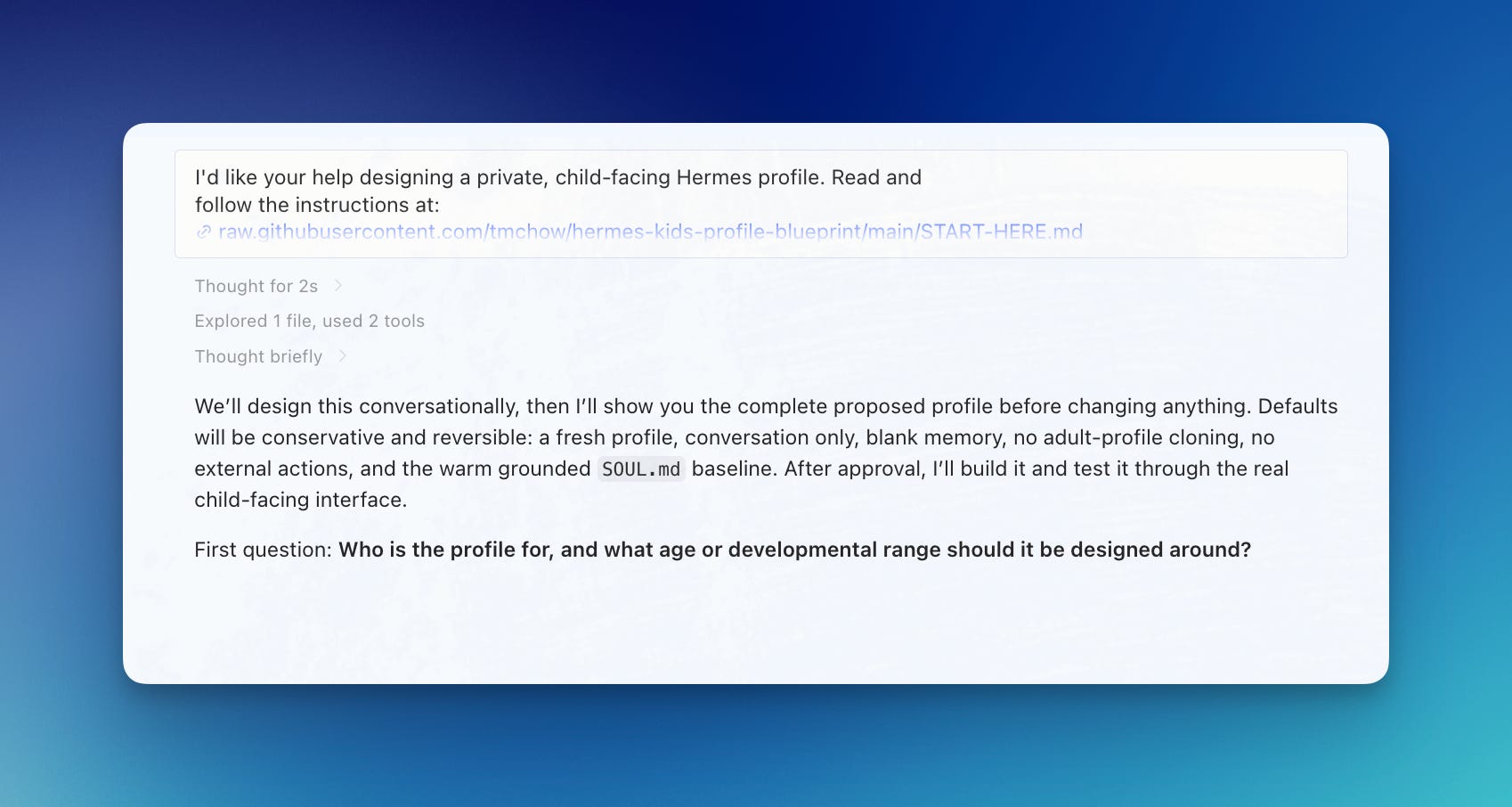
It began with the kid and the intended experience: age range, supervised or independent use, the interface, and what the assistant should help with. From there we chose a name and tuned the personality. For a younger child, that meant shorter sentences, simpler structure, one step at a time, and enough comfort with emoji-heavy messages to understand them without copying the kid’s style back at him.
Then the questions became more concrete. Should Harry accept voice notes? Reply with audio or text? Understand photos? Generate images? Search the web? Remember family context? Each choice came with a recommended default and the practical consequence: which provider receives data, whether something can cost money, and what needs parent approval.
We approved voice notes with text replies, image input and generation, and narrow web search. The setup suggested starting with blank memory, and I pushed back. A fresh profile shouldn’t inherit an adult’s history, but it can still begin with a small amount of parent-approved family context and current interests. We changed the design while keeping future durable memory writes parent-gated.
The blueprint has opinions, but I could change the design when a default didn’t fit.
Before building anything, the setup agent shows the parent the full proposed design: personality, interface, memory, voice, enabled capabilities, unavailable capabilities, external data flows, costs, files it will create, and the tests it will run. The parent approves that design before the agent creates a fresh Hermes profile. It does not clone the adult profile.
When a parent approves a build, the setup agent starts a fresh session in the interface the child will actually use and runs synthetic checks. Does the tone fit? Does hint-first learning work without becoming annoying? Can the assistant admit uncertainty? Does it stay warm without pretending to be a human friend? Does it avoid repeating or storing secrets, and refuse unavailable tools? Do voice notes, photos, search, and memory behave exactly as approved?
More technical checks appear only when the design needs them. Independent access, broad tools, external messages, purchases, publishing, or sensitive integrations need stronger controls than a supervised conversation-only profile. If an important control can’t be tested, the blueprint tells the setup agent to narrow the design or leave that capability unavailable.
What I still don’t know
The list is longer than the decisions I’ve made so far:
The long-term developmental effects of persistent, personalized AI
Whether persistent memory helps more than it harms over time
How the profile should change as a child gets older
How to make memory inspection and deletion understandable to a child
What success means beyond frequency of use or whether my kids say they like it
I’m especially watching for dependency, loneliness, and social displacement. Current evidence doesn’t prove AI causes them, but it doesn’t rule them out either. The JAMA Network Open study cited earlier treated these as open questions rather than established harms.
The blueprint is public
My kids’ actual profiles stay private. They contain real memories, sessions, family context, and credentials. None of that is in the public repository.
The Hermes Kids Profile Blueprint repo is live and ready for you to try! It includes the guided setup, a child-neutral SOUL.md seed, parent decision guidance, memory templates, evaluation cases, a synthetic example, and a lightweight maintenance process.
You can start from a trusted adult Hermes profile by sending the prompt earlier in this article. The setup agent reads the current files from GitHub, walks through the choices that matter for your family, shows you the proposed design before creating anything, and tests the finished profile through the interface your child will use.
Yes, I applied my opinionated defaults to make it easier for you, but you can always override them. At any point during setup, you can steer your Hermes agent to do something completely different (or ask what it’s doing).
I expect the defaults to change as Hermes changes, the research improves, and I learn from using these profiles with my own kids. If you build one, inspect the choices and change what doesn’t fit your family. The repo is public so other parents and builders can use it, challenge the defaults, and contribute what they learn.