

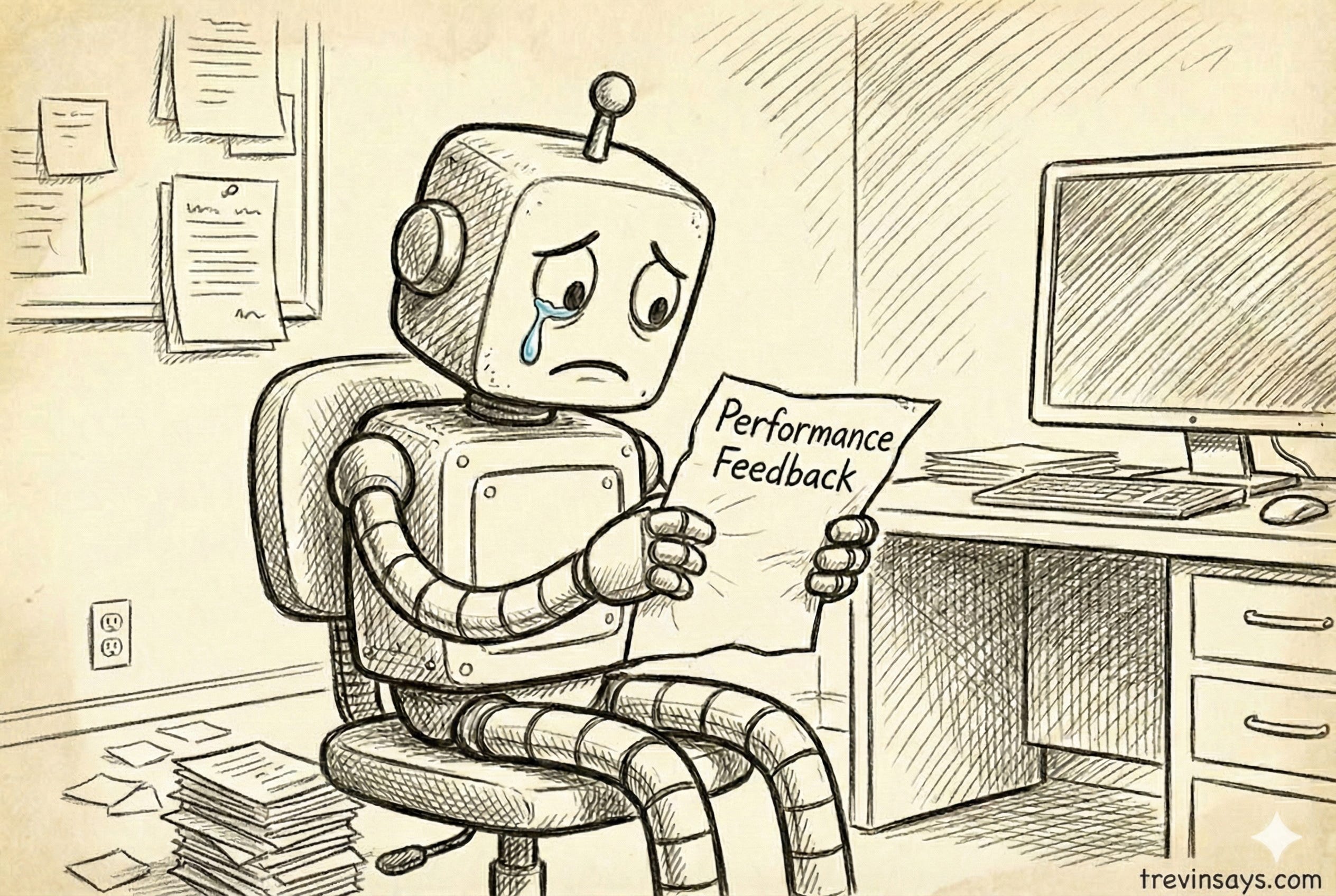
Leaders are spending more time working alongside AI agents, and these digital teammates are efficient, tireless, and require no appreciation, no development conversations, no retention strategy. You can be terse with them, use profanity, be demanding, and even dismissive of their “feelings” because they don’t have any. They work around the clock without ever complaining.
I’ve written before about how we need to stop thinking in human time when it comes to AI agents. The other thing to consider is when you spend significant time working with agents, it can shape how you perceive and interact with your human colleagues.
Stanford psychologist Jamil Zaki has been tracking what he calls the “empathy gap” between leaders and their teams, and AI appears to be widening it. More than 80% of workers say AI will make human connection more important, but only 65% of managers agree. In surveys where leaders praise empathy as a core value, more than 90% of employees say their organizations still fall short. The disconnect is measurable…and it’s growing.
A Duke study published in PNAS last year examined how colleagues perceive workers who use AI:
"These judgments manifest as both anticipated and actual social penalties, creating a paradox where productivity-enhancing AI tools can simultaneously improve performance and damage one's professional reputation."
AI is already distorting how performance and competence get judged. Two popular management frameworks also aren’t helping.
Founder Mode didn't mean what people wanted it to mean
Paul Graham’s “Founder Mode” essay landed a few years ago and became one of those pieces that everyone wanted to cite and clap back at something they didn’t like in their companies. Graham’s actual argument was that founders should stay hands-on and make decisions themselves rather than defaulting to “hire good people and give them room to do their jobs.” He contrasts this with “manager mode,” which he critiques as leading to delegation that allows “professional fakers” to drive companies into the ground.
He even predicted the misuse in his own essay at the very bottom in his final footnote:
“As soon as the concept of founder mode becomes established, people will start misusing it. Founders who are unable to delegate even things they should will use founder mode as the excuse.”
Brian Chesky, whose talk inspired the essay, has since lamented on The Verge’s Decoder podcast that:
"First of all, people don't know what founder mode is. They think it means swagger. I remember a tweet that said, 'I'm going founder mode on this burrito.' I don't know what that means. That wasn't the message."
The team at Oxide put it more bluntly in their reflection on the essay:
“Founders are at grave risk of misinterpreting Graham’s ‘Founder Mode’ to be a license to micromanage their teams, descending into the kind of manic seagull management that inhibits a team rather than empowering it.”
Leaders now use “Founder Mode” as justification for micromanagement, harsh accountability, and dismissing the important human elements of leadership. But Graham’s essay is about decision-making authority and staying close to the work, not about abandoning care for your teams. You can make strong decisions while also prioritizing retention and development, because these are separate things.
Kim Scott’s Radical Candor framework also gets misread (and misused) in the same way. Her model requires two dimensions working together: “Care Personally” and “Challenge Directly.” Drop the first half and you’re not practicing Radical Candor. She even has a name for that quadrant: Obnoxious Aggression.
“Obnoxious Aggression is what happens when you challenge directly but fail to care personally. It’s praise that doesn’t feel sincere or criticism that isn’t delivered kindly. Obnoxious Aggression sometimes gets great results short-term but leaves a trail of dead bodies in its wake.”
—Kim Scott, author of “Radical Candor”
Leaders using “radical candor” as cover for harsh feedback without the care component aren’t being direct. They’re just being obnoxious. Period.
Performance reviews are a retention mechanism
Performance reviews serve multiple functions: development and improvement (what most leaders focus on), performance correction (what “candor” advocates emphasize), and forced communication of recognition and appreciation. The review is a structured, calendar-driven moment that exists in virtually every organization, a forcing function that means leaders don’t have to remember to schedule appreciation conversations because the system already requires them.
But if leaders approach reviews only as opportunities to deliver feedback and push for improvement, they miss out on a huge opportunity.
NPR reported on longitudinal research tracking employee career paths from 2022 to 2024, finding that employees who receive high-quality recognition are 45% less likely to leave their jobs over a two-year period, and those currently receiving meaningful recognition are 65% less likely to be actively job hunting. Yet only 22% of employees say they get the right amount of recognition for their work, and in May 2024, 51% of all U.S. employees were watching for or actively seeking a new job.
Gallup estimates that replacing an employee costs between one-half to two times their annual salary, and voluntary turnover costs U.S. businesses roughly $1 trillion annually. Those numbers get cited a lot, but the part that actually stings is more personal: losing someone you wanted to retain because they felt under-appreciated is a leadership failure. That kind of failure should haunt you, because it was preventable. The system gave you a built-in opportunity to show that person they mattered, and you spent it on pointing out what the person should be doing better at.
The work that only humans can do
As leaders spend more time directing AI agents, the temptation grows to apply that same efficiency-first mindset to human teams. But humans aren’t AI agents: they need to feel valued, they need to know their contributions matter, and they sometimes need someone to vent to. As AI handles more of our work, these elements of leadership become even more important. Empathy, recognition, and retention strategy are impossible for AI to provide. As Stefano Corazza, head of AI research at Canva, put it at the Fortune Brainstorm AI conference:
“The more AI there is, the more authenticity is valued. If your manager really shows that he will spend time with you and cares, that goes a long way.”
If you’re heading into performance review conversations in the coming weeks (or months… or whenever), remember what the system is actually giving you: a scheduled moment to show your people that you see them, you value them, and you want them to stay. Accountability and genuine appreciation have always coexisted. The review is already on your calendar, so treat it like a built-in opportunity to show someone they matter to you and the company.